AI Won't Replace Senior Engineers, It Just Revealed What Actually Matters
Thomas Kunnumpurath
VP Systems Engineering · Solace
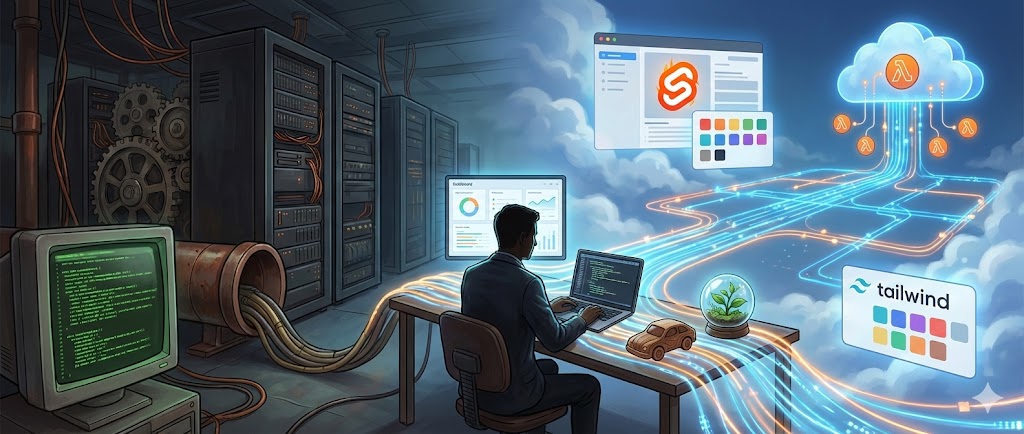
Last month, I needed to demonstrate a concept for an IoT integration with Solace, specifically an ESP32 streaming sensor data. Traditionally, getting a proof-of-concept like that from a vague idea to a working demo – especially one with enough polish to be customer-facing – would eat up at least a couple of days, maybe more. There’d be datasheet diving, library hunting, fiddling with build environments, and endless cycles of compile-upload-debug. This time? I had a functional, end-to-end system running within a day, including local inference for some edge logic. The secret wasn’t some new hyper-efficient workflow I invented; it was AI, and it dramatically changed how I spent that day.
The industry narrative around AI-assisted engineering often oscillates between two extremes: either it’s the harbinger of mass developer unemployment, or it’s a glorified auto-complete. Both miss the point. What I’ve seen firsthand, as a VP who still builds, is that coding agents have become standard tooling, and their true impact isn’t on replacing engineers, but on compressing the distance from idea to working proof while raising the premium on judgment, design, and system knowledge. AI isn’t a shortcut to skip learning; it’s a force multiplier that exposes the true value of experienced engineering.
From Boilerplate to Blueprint: My AI-Accelerated Projects
Take that ESP32 demo. My goal wasn’t to write every line of C++ for an MQTT client or sensor interface from scratch. My goal was to validate the architecture: how quickly could we get data from a constrained edge device, apply some local processing, and then stream relevant events reliably to a distributed event mesh for further analysis? AI handled the boilerplate with remarkable efficiency. I used Claude Code to generate the initial ESP32 firmware structure, the MQTT client setup, and even the basic sensor reading logic. It wasn’t perfect, but it got me 80% of the way there in minutes, not hours. This freed me to focus on the hard parts: optimizing data serialization for network efficiency, designing the topic hierarchy for the event mesh, implementing the specific local inference model on the ESP32 (running a lightweight anomaly detection), and architecting the failover mechanisms if the network dropped. These are the problems that require deep system understanding, not just syntax memorization. I also validated running that inference both locally on the device and on a MacBook for rapid iteration, understanding the actual performance and resource tradeoffs before committing to a final deployment strategy.
Another example is my own SvelteKit-powered Markdown blog pipeline. Migrating from Wordpress to a fully custom, static-generated blog might sound like a significant time sink, but AI streamlined much of the grunt work. From generating initial Svelte components for markdown rendering to scaffolding API routes for image uploads, AI accelerated the setup. This allowed me to concentrate on the system of content delivery: how to integrate with Cloudflare Workers for dynamic content or image optimization, how to ensure atomic deployments, and how to build a robust CI/CD pipeline. The core value wasn’t the code for a <h1> tag; it was the reliable, scalable, and maintainable system that delivered my thoughts to the world.
Even a local stock screener I built for personal use benefited immensely. The initial data fetching scripts, basic UI components, and even some preliminary backtesting logic were quickly generated by an AI assistant. My job became ensuring the data sources were reliable, defining the actual screening criteria (which involved complex financial logic, not just parsing JSON), optimizing the data processing for performance, and building an alerting mechanism on top of it. AI helped me experiment with different technical implementations quickly, allowing me to refine the investment strategy — the core “why” — faster.
The New Senior Engineering Value Proposition
What these experiences highlight is a fundamental shift. The conventional wisdom that senior engineers spend their days writing vast amounts of code is increasingly outdated. AI takes care of much of the how – the syntax, the common patterns, the API integration details. This isn’t a threat; it’s an opportunity.
For senior engineers, this shift elevates the premium on:
- Judgment and Design: With AI handling the tactical implementation, our time is freed to focus on architectural decisions, system design, data modeling, and making critical trade-offs (e.g., edge vs. cloud inference, synchronous vs. asynchronous communication, Solace vs. Kafka for specific use cases). These are problems AI can’t solve, because they require context, experience, and an understanding of business implications.
- System Knowledge and Debugging: When something goes wrong in a complex distributed system, AI can’t diagnose the subtle interaction effects between services, the latent race conditions, or the cascading failures. That still requires an engineer with deep knowledge of the entire stack, from network protocols to application logic, and the ability to correlate disparate logs and metrics. My years running messaging middleware at Deutsche Bank taught me that architectural judgment under pressure is irreplaceable.
- Prototyping and Exploration: The speed AI offers means we can explore more architectural options, build more proof-of-concepts, and validate assumptions faster than ever before. This allows us to fail faster, learn more, and ultimately deliver better, more robust solutions. Running inference locally on my MacBook to quickly test models before deploying to the cloud or an ESP32 is a perfect example of this accelerated exploration.
- Mentorship and Leadership: If AI handles the junior-level coding tasks, the role of senior engineers shifts more towards guiding teams, setting technical direction, and instilling best practices for design and architecture. Our experience in what not to build becomes more valuable than ever.
The Real Shortage: Not Coders, But Architects and Problem Solvers
The real shortage in our industry isn’t in people who can write code; it’s in people who can design resilient systems, make sound architectural decisions, and understand the true business problem they’re trying to solve. AI coding tools are making this distinction starker. They amplify the senior engineer’s strategic capabilities, allowing us to operate at a higher level of abstraction and impact. My day, as a VP, now involves far less rote coding and far more rapid architectural iteration and problem-solving, all while still getting my hands dirty shipping actual code. It’s not about being replaced; it’s about being refocused on the problems that truly matter.
If you’re a senior engineer feeling the pressure, embrace it. Double down on system design, distributed systems patterns, and understanding the core business domain. That’s where your irreplaceable value lies, now more than ever.