Beyond the Log: Why Solace PubSub Excels for Mission-Critical Event Architectures
Thomas Kunnumpurath
VP Systems Engineering · Solace
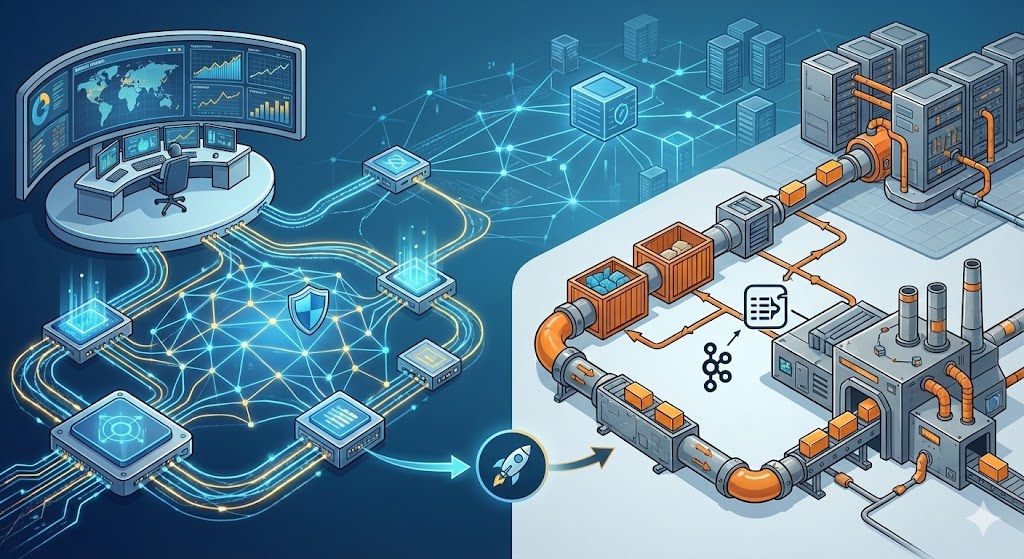
In today’s fast-paced digital economy, real-time event-driven architectures (EDA) are no longer a luxury – they’re a necessity. From instant financial transactions to responsive customer experiences, the ability to react to events as they happen defines competitive advantage. As a seasoned engineering leader with nearly two decades in fintech and systems architecture, I’ve had a front-row seat to this evolution, first as a customer and now as a key part of Solace.
The Rise of Event-Driven Architectures and the Kafka Conundrum
When we talk about modern messaging, Apache Kafka often dominates the conversation. And for good reason: it’s a robust, scalable distributed commit log that has enabled many companies to handle high volumes of data. At Capital One, for instance, when we were building high-performance microservices in GoLang and Java Spring Boot for critical credit card controls, the need for reliable data streaming was paramount. Kafka certainly played its part in many architectures, providing a durable backbone for data ingestion and batch processing.
However, while Kafka excels as a log-oriented, stream-processing backbone, it’s crucial to understand its fundamental paradigm. Kafka is designed around a partitioned, immutable log where consumers pull data from specific offsets. This model is powerful for stream processing and replayability but can introduce complexity when the requirement shifts from ‘durable log’ to ‘dynamic, mission-critical message routing’ across a diverse ecosystem of applications, services, and devices.
This is where my experience, honed over years, repeatedly points to Solace PubSub+ as the superior choice for mission-critical event-driven workflows.
A Decade of Real-World Event Handling: From Deutsche Bank to Solace
My journey with Solace didn’t start within the company. For nearly a decade, I was on the user side at Deutsche Bank, running mission-critical real-time trading systems. These systems were the very heartbeat of the bank, where every millisecond, every message, directly impacted P&L and regulatory compliance. We were grappling with the limitations of existing messaging technologies, specifically TIBCO Rendezvous, and needed a solution that could guarantee delivery, scale globally, and provide unparalleled operational resilience.
It was during this time that I spearheaded the firm-wide migration to Solace. This wasn’t a casual decision; it was a deeply researched, high-stakes move driven by the absolute necessity for a messaging platform that could handle low-latency trading support, integrate seamlessly with our Core Java and KDB+ systems, and offer true enterprise-grade stability. The shift to Solace was transformative, providing the robust, high-performance foundation our trading floors demanded.
Now, as VP of Systems Engineering at Solace, leading a team that’s grown from 5 to 15 pre-sales engineers and even spearheading the go-to-market for Solace Agent Mesh in the Americas, I have the unique perspective of both a critical user and a core architect of our solutions. This dual vantage point reinforces my conviction: Solace PubSub+ addresses the nuances of mission-critical EDA that Kafka, by design, often leaves as an engineering challenge for its users.
Why Solace PubSub+ Triumphs for Mission-Critical Events
Let’s break down the key differentiators that make Solace PubSub+ the preferred choice when event reliability, global reach, and operational simplicity are paramount:
True Pub/Sub vs. Log-Oriented Streaming:
- Kafka: A distributed commit log, fantastic for stream processing where consumers pull from specific offsets in topics. Each consumer group manages its own offset. Replayability is a key strength.
- Solace PubSub+: A true publish/subscribe broker. It actively routes messages to interested subscribers based on content (topic subscriptions). This fundamental difference means Solace optimizes for dynamic, real-time message delivery across complex event meshes, ensuring the right message gets to the right place, immediately, without consumers needing to manage offsets or coordinate across groups for delivery.
Guaranteed Delivery and Persistence Done Right:
- Kafka: Achieves guaranteed delivery through replicated logs and consumer offsets. Managing consumer acknowledgments and ensuring exactly-once processing can be intricate and typically requires custom application logic.
- Solace PubSub+: Offers robust, hardware-accelerated (with appliances) and software-defined message queues that simplify guaranteed delivery. Solace handles complex messaging patterns like fan-out, prioritization, and dead-letter queues out-of-the-box. Developers simply connect to a queue and consume, with the broker handling persistence and acknowledgments. This dramatically reduces application complexity and the risk of message loss.
Global Event Mesh & WAN Optimization:
- Kafka: For multi-datacenter or global deployments, Kafka typically relies on solutions like MirrorMaker or Confluent Replicator. These are often complex to set up, manage, and introduce latency, making true global real-time event distribution challenging.
- Solace PubSub+: Built from the ground up to create a global event mesh. Its patented WAN optimization and dynamic routing capabilities allow events to flow seamlessly and efficiently across geographically dispersed environments, including hybrid cloud, multi-cloud, and edge locations. When I was at Deutsche Bank, connecting trading floors across continents with minimal latency was non-negotiable, and Solace delivered.
Operational Simplicity and Total Cost of Ownership (TCO):
- Kafka: While powerful, managing Kafka clusters at scale requires significant operational expertise and resources, involving Zookeeper (or KRaft), brokers, and potentially a vast ecosystem of connectors. Scaling, patching, and monitoring can be demanding.
- Solace PubSub+: Known for its ‘set it and forget it’ operational ease. Its self-healing capabilities, intuitive management tools, and robust design reduce the need for large operational teams. This translates directly into lower TCO, allowing engineers to focus on business logic rather than infrastructure plumbing. My team at Solace consistently demonstrates how this simplifies complex deployments for our customers.
Protocol Diversity and Enterprise Integration:
- Kafka: Primarily speaks its own high-performance binary protocol. Integrating with other enterprise systems often requires Kafka Connect, adding another layer of components to manage.
- Solace PubSub+: Supports an unparalleled breadth of industry-standard protocols natively – SMF, AMQP, MQTT, JMS, REST, and WebSockets. This versatility is crucial for diverse enterprise environments, allowing seamless integration with legacy systems, IoT devices, microservices, and modern web applications without additional gateways or complex transformations.
The Hands-On VP’s Perspective
My technical philosophy is rooted in what works at scale. While I’ve experimented with Rust, enjoy building with SvelteKit and Cloudflare Workers for personal projects, and still appreciate the power of GoLang and Java, the backbone for enterprise-grade event-driven systems needs to be rock solid. I’m a proponent of EDA because I’ve seen it unlock immense value, but its success hinges on the underlying messaging infrastructure. You can have the most optimized GoLang microservice, but if your message broker isn’t performing, your entire system suffers.
Kafka is an excellent tool for many use cases, particularly log aggregation and stream processing. But for the true demands of mission-critical, real-time event distribution – where high availability, robust guaranteed delivery, global connectivity, and operational efficiency are non-negotiable – Solace PubSub+ stands out as the superior choice. It’s the platform I trusted as a user, and it’s the platform I continue to champion today, especially as we build the foundations for the next generation of AI-driven agentic solutions.
Choosing your event backbone is one of the most strategic decisions you’ll make. For those mission-critical workflows where failure isn’t an option, look beyond the log and embrace the power of a true enterprise-grade event broker.